Monday, October 1, 2012

Kitty...

So its no secret that my bestie in the village is my cat, Kitty. I got her only a few weeks after arriving in Balng'ombe (It's a boy but I call her a she because it just sounds right).
Anyway, Kitty died on Saturday rather unexpectedly, and it just really hurts.
I had been in Dedza teaching the newer group about how to make sanitary pads. I noticed that Kitty was looking a little strange before I left- her nose was pale and she seemed extra hot. But she was young, and still active and I just figured it was something she could fight off.
I came back four days later from Dedza to find her sprawled out on my bed, too pale to be ok (her gums and sclera were pure white....not good). In the morning she seemed a bit better and took a little walk around my garden, but by noon I knew she needed to see a vet, stat. I scrambled around making phone calls (most Malawians knock off pretty early on Fridays and I was a good hour and half outside of the city..)
A nice Belgian vet agreed to stay in late to see me. I assured her that I could be there in an hour, then stuffed Kitty in a basket and ran out the door. I bribed/compensated my Imam friend to take me out the 5Km to the road right away. He can't drive on the paved road though because his car doesn't have license plates. So I started hitching. Immediately I got picked up by a trucker, who agreed to take me into town, even directly to the general area where I needed to go (I was crying by this point).
Once in the neighborhood, I called the vet again to get directions. It was a jumble of turns that I couldn't write down fast enought before my phone ran out of call time. Houses and streets in Lilongwe don't really have names or numbers. There are numbered areas, and then the houses in that area are numbered according to the order they were built in. So, for instance, a house may say 3/34, which means that it was the thirty-fourth house built in area 3. Very helpful, I know.
I tried to walk to this vets house, but got utterly lost, burst into fresh tears and tried hitching again. A lovely Malawian businessman picked me up (complete with moaning cat). We couldn't find the vet, but he felt so sorry for me that he kept stopping and asking people if they knew where it was. Finally one guy did- he actually got into the car with us and showed us the way. This driver wouldn't even accept any money for gas...sometimes I am shocked by the kindness here.
Miraculously, I did in fact make it to the vets within the hour that I had promised. She said that Kitty was severely anemic and was in septic shock. She tried to start an IV, but Kitty literally wouldn't even bleed... at all. She gave her some anti-parascitic shots and then started giving normal saline subcutaneously (just injecting it under the skin). After a few minutes of this, Kitty had a seizure and went into full on shock. Because of my background as a nurse I knew that Kitty was dying but I had no idea what to do about it. Helplessness is the worst.
Kitty stopped breathing for a minute, and her heart started beating erradically. The doctor was about to say she had died when her heart just shuddered and restarted, and soon enough she was breathing and conscious again. The vet couldn't keep her overnight, so she gave me a bunch of syringes and fluid and told me to keep giving her the saline shots. Total bill: about $9.
At this point the vet realized that I had in fact hitchiked to her house and had no way of finding my way out of her neighborhood. So she drove me to the city where I frantically called my friend, Mary, and asked if my cat and I could stay for awhile.
That night, at Mary's house, Kitty was in and out of consciousness. She would see me and there would be a glint of recognition but then her eyes would glaze over and she would be out again. I stayed up giving her the saline shots, and even managed to get her to take some antibiotic pills and water. At one point she was well enough to hop up onto the bed. We snuggled ferociously.
In the morning she was moaning and wheezing again. She couldn't stand up. I laid next to her in the bed as she lost consciousness for the last time. There were about ten minutes of agonal respirations. Then I could feel her heart slow down, speed up, then flutter and stop. I held her for another two hours.
Fortunately Mary's neighbor is an animal lover (a large animal vet.) Since his housing is a bit more permanent than ours, he offered a nice gravesite in his yard. I tucked Kitty and her blanket in a box, and said goodbye.
Now I'm in Lilongwe, getting ready to return to an empty house.


Tiwonana Kitty....ndimakukhonda......

Monday, September 24, 2012

My Hens, Updated :-)

In the evening

In the morning!
Two weeks later...
Watching my hen reminds me of that scripture..." How often I have wanted to gather your children together as a hen protects her chicks beneath her wings, but you wouldn't let me."

Sunday, September 9, 2012

Summer/Winter in Malawi

 So here in the Southern Hemisphere "summertime", when school is out and the Peace Corps runs Camps, is technically winter. That doesn't mean its not still tank top weather, just that at nighttime one requires many, many layers of tank tops to stay warm.
In July and August, Cait and I taught at both big Camps that Peace Corps runs; Camp Glow and Camp Sky. I taught a session to 60 girls about reproductive anatomy and physiology, family planning and STD's. Believe it or not there were a lot of laughs- along with a lot of really good questions from the girls (and 'aha' moments). Althought this stuff is all supposed to be taught in secondary school the truth is that it usually isn't. Most Malawian teachers are male and don't feel comfortable teaching proper sex ed. Girls get a lot of bad advice here. For example, many girls had been told that if they abort a baby, the father immediately dies too. The fact that rape can happen within marriage was a new idea to almost all the campers. One of the most common problems is that girls don't even bother going to school when they have their periods because they don't have any leak-free options for hygiene.

 In a second session, Cait and I taught 90 girls how to sew their own reusible fabric menstrual pads. And -surprise- we handed out full sets of fabric pads to each girl!! Now they have enought to get started going to school EVERY DAY, and the skills to sew more. The girls here are often convinced that boys can tell when they are on their periods through magic or special senses. We taught them that if they walk tall and confidently, they don't have to worry about anyone "knowing".

 Happy happy girls :-) Several of them pleged to show their friends how to sew the kits and a few even expressed an interest in sewing them as a business. Meanwhile several other PCV's want to start local pad-sewing projects at their site. AND Cait and I have been invited to teach the pad making to the mother's groups at all 32 primary schools in our area. Fun fun fun. Very busy though.


 Inno is fat and happy
 Kitty owns the night.
One night Kitty showed up completely soaking wet. (There is no running water in my village, no rain for 4 months, the river is dried up. How, Kitty, How??)
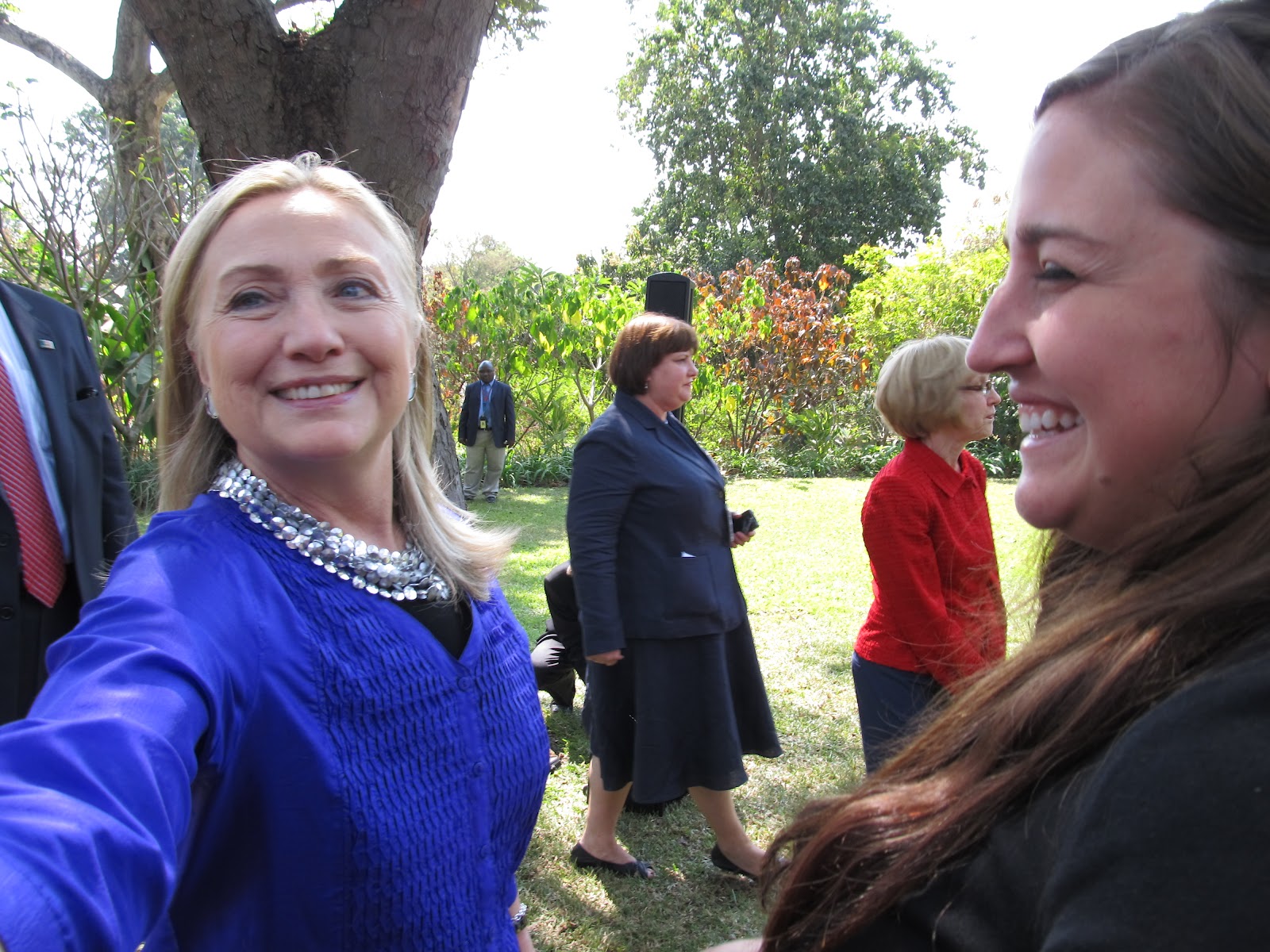
Oh and we met Hillary Clinton. Surprisingly beautiful in person!

Wednesday, July 25, 2012

Fourth of July Vacation- complete with Pirates!

My Fourth of July vacation began with a reception at the Ambasassador's house. Very chic. I had the privilege of meeting William Kapalamula, who wrote 'The Boy Who Harnessed the Wind'. If you haven't read that book go get it!
 His English was waaayyy better than my Chichewa :-)
 On vacation at Nkhata Bay- one of the most beautiful places I have ever been.
 The water was very clear with lots of cichlids. Perfect for snorkeling.
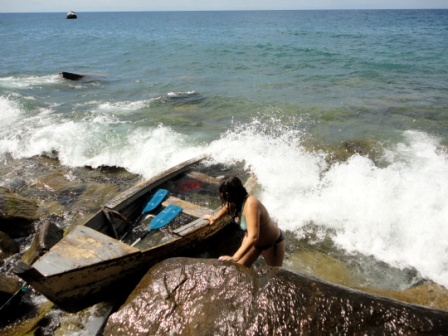
 We took a rowboat out to explore Lake Malawi.

 We found a little cove and tied up the boat in what we thought was a safe spot.
 Then the waves kicked up ;-(
 More waves
 The boat is very much in trouble
 Some fisherman came and helped us
 They wanted an extravagant amount of money for helping, which of course we didn't have....
 So they "escorted" us back ot the lodge and demanded the money from them.....I said "Carolyn, isn't this what pirates do??". They eventually settled for 4,000mk. Now Carolyn and i officially know what our lives are worth :-). Oh, and that includes the rowboat.
Memorable souvenier bruises!

Thursday, June 28, 2012

The Picture Post!

Riding the Lorry home after a busy day in Lilongwe

Balang'ombe- Home sweet home

Instead of just laughing to myself at funny shirts (that people here don't know are funny, I have started complimenting them and asking if I can take a picture :-)

A member of the school Mother's Group at the first training session I did on sewing reusable feminine hygiene pads

I want YOU in the US Peace Corps!!

Net Distribution day at the Health Centre. This man is explaining a poster that instructs people to not sell their mosquito nets 

True true

Inno in a sweater!! Do my neighbors think I'm crazy? Yes they do!!

SuperGirl

The second Mothers Group training session- which was held outside in a windy plateau.

Monday, June 11, 2012

Bedroom Intruder

So in general I'm feeling better- I'm over my mid-service crisis and quite at home in my little dusty savannah town. Inno is outgrowing her baby fat and is becoming strong enough to PULL me when I put her on a leash. She still tries to make friends with everything. Last night she tried to say Hi to a very large, very pregnant goat, who then head butted her. Inno flew back a few inches, landed on her bum, and then smiled and panted at the goat, happy that a new friend had been made. Wilfred happened to be watching on the other side of the fence and was rolling over laughing, saying "Inno thinks she is a goat!"
Last week something scary happened. It was 8:30 at night (it gets dark here now at 6pm), and Inno was barking her little head off. Very strange. I went outside so make sure she was ok and saw a man crouching down behind my bafa. Yikes! My house has a main part and then a set out outbuildings, including my latrine and where I take my bucket baths. The man was scurrying around out there in the darkness, just beyond the scope of my headlamp.
I headed back inside, locked the door behind me, and tried to call Wilfred from my living room. Of course he was asleep and his phone was off. Oh well, I figured. The man knows I saw him, he probably ran away. On my way back into my bedroom, I picked up an arrow that I got with a souvenier arrow set in a curio market a while ago. I guess I thought it would make me feel safer. I had on my tiny (batteries dying) headlamp in my room when I spotted the man crouching at the foot of my bed.
I had left my window open. This was not good.
I was really angry- not really afraid, just angry. I held up my arrow and yelled a bunch of questions at him in English. It didn't really occur to me to speak Chichewa. The man was actually quite timid and seemed very afraid of my arrow. I ordered him out, but the back door was locked so I had to fumble around for my keys before I could shove him out the door. Then I got REALLY angry. I grabbed his collar and the thought passed through my mind that I was going to march him right over to Wilfred's and make him explain when he had done. But this time he finally pushed back and ran away, out through my broken fence. Inno let loose one last bellow of growls.
Then I realized what had happened and I started shaking. I knocked on Wilfred's window, and called the Peace Corps. The bars in the window were fixed the next day, and I am getting the mother of all replacement fences put in.
I have a lot of alone time back at site to analyze my response. Fortunately I have a lot of experience in stressful situations thanks to my previous career as a night nurse in a public hopspital. It bothers me that I was so quick to pick up an arrow, as I am quite the avowed pacifist. Most people here say they would have really hurt him and are surprised that I didn't. I know it sounds corny and idealistic, but I actually felt a pang of guilt that I coudn't solve my differences with this guy though dialougue. But then again, he was in my bedroom at night.....I don't know.
What I do know is that he has tried to enter four more homes since then. I also spotted him back in my yard three nights ago. I yelled at him and he ran away. My village doesn't have police but the "village good guys" are working on the problem.
On a much lighter note, I finally made a spinning wheel here in Balang'ombe! I managed to buy an old bicycle wheel and with some rought hewn timber, a borrowed (extremely dull) saw and lots of duct tape, I have a great wheel :-) Its wonderful to have an alternative to my drop spindles, especially now that I am getting some fiber in care packages.
Special shout out to Sugar and Spice Alpacas- they sent me a lovely bump of brown alpaca roving- thanks!
 It was quickly turned into a ribbed cap to wear at night. It gets cold here in the Southern Hemisphere Winter.
All right- 10.5 months to go :-)
Grace and Peace
Elizabeth

Monday, May 7, 2012

You know how sometimes it has been so long and so many things have passed that need describing, that you don’t know where to begin? And so instead of beginning, you swear that you will write tomorrow. And then the next day, and then the next. And then some months pass.
So it is. I’ve been here in Malawi over 14 months, and in Balang’ombe over a year. This is my home. But the disconnection is still there. I still wake up and wonder where I am, and I still dream about shopping in America. I sleep and I’m in IKEA. I wake up to feed my chickens. I sleep and I’m in Sephora, buying mini bottles of Burberry Brit.
A while ago I woke up to find a green mamba, the same color as my bright lemongrass, sliding through my garden. We locked eyes and it slithered as I grabbed Kitty and flung her into the open window to safety. (I guess I know now how I react to danger- at least when my cat is around.) I went to grab my camera, but the mamba was gone. That day I took my neighbor’s advice to cut my grass. I have a hand-scythe that slices chunk by chunk through the viny, tough greens left over from the rainy season. I took the clippings and made nice beds for my chickens. Baby started laying eggs again last Thursday.
Shortly after the mamba morning, I returned to find my garden beds all scuffed up. Wilfred apologized. There was a rabid dog stuck in my garden- it couldn’t find it’s way out for a long time. Wilfred waited for it in the dark, outside my gate while I was spending the night in town. He “took care” of it for me. Over the next few weeks he took care of three more rabid dogs. I called the PCMO, panicking. “I feel like my environment is trying to kill me.”
            “You’re in Africa. Some of the things around you are dangerous. You can deal with it.”
            “Ok.” Deep breath.
            I bugged the district vet tech for some rabies vaccine for Kitty and Inno, and when I finally got my hands on a vial, I gave the injections myself. Twelve days later, Inno came home bleeding.
I called the PCMO again.
            “How long does it take for the rabies vaccine to start working?”
            “Ten to fourteen days. Watch for abnormal behavior.”
            I have never owned a dog before, and everything that Inno does, the half-wild, inbred, dumb mutt that she is, started to seem abnormal. I asked Wilfred if he would “take care” of Inno if she had rabies. Yeah. A good neighbor is one that will take care of things.
            But Inno is still alive. Its been six weeks now since she got the vaccine. She grows and grows and does stupid things like chase around Wilfred’s anemic little runt, Precious, until both of them are just rolling in the ground, panting and exhausted. Kitty looks on judgementally.
            Then the President died. I was helping to delver a baby when I got the text. I took it around to all of the other staff in the Health Centre. Everyone already knew that he was dead. He had been dead for two days, but this was the government finally confirming it. And all of a sudden, the country where I had been raging and bellowing about womens’ rights had a woman President. A week and a half after the First Lady came to Balang’ombe for World TB day, she wasn’t First Lady anymore. Today the Kwatcha has been formally devalued; a move that the IMF has been prodding Malawi to do for three years. The fuel lines are gone. The sugar rationing has stopped. Things can change so quickly.
            Right now I have the blues. Every once in a while life stops becoming a pleasant swim in warm blue oceans and the water starts to bowl me over. My footing gets lost. And so I’ve spent a lot of afternoons sitting on my back steps, staring at my chickens and trying to cheer myself up. I’ve had long talks with the PCMOs, and they are encouraging. I remembering how fortunate I am. I think of things I am grateful for, things that make me smile.
I know I’ll get better and the storm will pass and I will be back out there swimming along, basking in the ebbs and flows of my community. Till then I’m hanging on, knowing that wherever I go, there I am. I am American but I am not. I am Malawian, but I am not. I am only me.

Saturday, February 11, 2012

From Lusaka with Love

This week my good friend from Seattle (now living in Lusaka) came over to check out village life. Laura is a nurse like me but since she is not in the Peace Corps, she has no restrictions on doing hands-on care. She hit it off with the midwives and was helping to catch babies in no time!
Laura got on a bus in Lusaka at 10:30 which sat, and sat, and sat in the bus depot until almost 6pm! Meanwhile I had travelled to the Zambian border town of Chipata, to meet her and spend the night before we continued to my village. She finally arrived at 2am. We got a few hours sleep and then rode about eight more taxis, minibuses, and trucks to arrive in Balang'ombe just before sunset.
Laura took to village life like a real trooper- bucket baths, candlelight, the constant flow of visitors (and people curious to see the new azungu)- no prob! And thank God Laura is a dog person. She had a mesmerizing ability to calm Innocent, whereas I have no idea what to do with this newly fat, happy and HYPERACTIVE dog.
By the way- Innocent is a little Wakuba- thief. She can't figure out where her own tail is it seems but she is excellent at noticing when my neighbors are cooking nsima so she can sneak a patty back out to my yard. We took Inno to the market and she started gnawing on some corn fritters that were for sale (don't worry, we bought them). For the rest of the market, Laura held Inno to keep her from stealing stuff, and people found this VERY interesting. Not only is this a brand new azungu, but she's holding a dog! Crazy. We were looking in the famous 20 kwatcha pile and I held up a weird looking pastel ski mask. Ohmygod! Laura said- it's a doggie sweater! So now everyone was staring at the new azungu holding a dog that was wearing a sweater. I had already assumed that most of the people in my village think I am crazy. Is there a level above crazy?

In the evenings, we would sit outside, drink our tea, and watch as Inno and Rocky (my neighbor's dog) played and growled and rolled around in the dirt. The gaggle of local girls who like to hang out at my house came over almost every night, and sometimes, when things got slow, I would blow them some bubbles (which they love more than candy). We were sitting out there, and Laura was like, 'I love this. I could totally live in a village and be happy.' Yup. So can I. :-)


My Little Visitors


Starting on Monday, Laura headed over to the Labor and Delivery wing of the Health Centre and started helping out. In fact, when we first arrived, a baby was already crowning. The birth was totally normal, but the mom (17 y/o) was really having a rough time and her Agogos were screaming at her to push harder and at one point even hit her. Laura just started cooing and holding the Mother's hand and the baby slid right out.
For baby number two, I was teaching my English class while Laura spent the entire day with the mother in labor. It was another normal pregnancy, and then THAT baby slid out, Laura caught it, with the midwife looking on. The mom named the baby girl "Rola" (Malawians can't pronounce 'Laura').
The third baby was breech, butt first. The poor midwife had been calling for an ambulance all night but because of the fuel shortage nothing came. The midwife warned the Agogos that the birth was very risky and the baby might not make it. When it was finally out, it was blue and not breathing. There was no suction, so they just hand- bagged it for a few minutes and rubbed it and prayed. Then there was the best sound of all- the baby cried and I got to be the first to tell the Agogos that the baby lived and that it was a girl. Timasangalala Kwambiri!!
Needless to say, Laura had a great time with the baby-mommas and midwives.


Laura and Nurse/Midwife Margaret.

So now I have a calmer dog, a better understanding of what happens here when a woman is giving birth (I never worked as a Labor and Delivery RN, so I had been kind of avoiding the L&D wing for awhile), and a renewed sense of awe for my village and lifestyle. You know how sometimes you never really appreciate somthing until you see it through another person's eyes??
Thanks Laura- Balang'ombe misses you!
Grace and Peace
Eliza


Monday, January 23, 2012

Still here!

Happy Rainy Season!
Things are going well here in Chiwamba/ Balang'ombe, and my household is ever expanding. Everything is green and lush and muddy. The river valley to the secondary school is impassable, which is a pain because now I am teaching Life Skills twice a week. I think I had envisioned sparking deep debates about the philosophy of wellness and long brainstorm sessions about paradigm-changing health ideas. Instead this week we talked about the importance of washing one's feet after one walks through mud. Practical I know. There WILL be a test.
Seriously though, this is a village school, which is the lowest tier of education for thoese students in malawi who pass grade 8. Most are barely passable at speaking English, which is the language I am required to teach in. So we are starting with the basics.. Self-esteem, hygiene, gender-equality, basics of HIV. If we can get everyone consistently washing their hands I think I will shed a happy tear.
The Youth Centre grant went through, and ground was broken in December. We are now well into construction, and everyone is super excited. I spent the ground-breaking day helping to tear down a small existing building on the site, so that we can reuse the bricks. A bunch of Amayis started a bucket line for the debris and started pumping me with questions about how many kids I have, how long ago I got married, etc. When I told them that I live along with my cat and chicken, they assumed they were misunderstanding my Chichewa, and called over another English speaker. When she confirmed that I was single, the Amayis put down the bricks and started the much harder task of convincing me that I should marry their nephews/grandsons/etc...
Baby, my hen, started sitting on her five eggs on Christmas Day, and sure to Wilfred's calculations, they hatched 21 days later. Only three of the five hatched, two black ones and a yellow one. I call them Baby 2.0 (I can't tell the two black ones apart, so they both have the same name) and azungu. They are growing daily, following their mama from food source to food source, and then parading back into their roost at night. Once I can tell what gender they are, I will keep the hens for eggs and give away the roosters.
So last week I got a puppy. I have never owned a dog before, so it was a bit of a surprise. I was away, in Sajiwa, about 10k from Balang'ombe. I was supposed to be in a church., but my hip was bothering me so I got up to walk around and started talking to an old woman in a tiny mud hut. The whole time we spoke, this little, itsy bitsy, runt of a puppy was wandering around in front, looking in vain for somethng to eat. I asked about it's mother (missing) and then took a deep breath and offered 100 kwatcha for it (about 50 cents). The old lady grinned, picked up the puppy and threw it toward me. I wrapped it up in my chitenge. It was covered in fleas and ticks and was so malnourished its hair was falling out in chunks. A downpour started, and we had to walk in the mud for the last 5k to my house, which took an hour and a half. I tied my Chitenge so that the puppy, now named Innocent, (after a particularly fetching young Rasta I met...) was up against my chest staying warm. First step when we got home was a hot bath. She vomited her first few meals but is now flea-free, eating ravenously, and her hair is starting to get every so slightly glossy. Of course both Kitty and Baby hate her, but they'll come around.

Going to try to load pics, but the internet is ssslllllooooowwww today.
Grace and Peace.

Monday, October 24, 2011

Pictures!

I know, I know, I haven't posted any pictures yet. This post will try to remedy that. This is me with my Malawian Host sister (for training) Jessie. Doesn't the grandma in the back sort of look like a vampire though?? :-)


Three of the four quadruplets from my host family. We called them the Children of the Chimanga (corn) because when the other PCVs and I went for walks, they would follow us from different paths, so we would see one, then turn around and see another identical one, and on and on. Creepy but cute.

Learning borehole maintenance at IST.

Monday, September 26, 2011

Itty Bitty Kitty Committee

So I have a cat, which is news because in America I was really allergic to cats. But after several months (and tentative feline encounters) in Malawi, I have come to the conclusion that I am somehow NOT allergic to the cats here. Don’t ask me how that works, I don’t know. But there is just no reaction here.
 Palibe vuto. Pepani.
So after being in Chiwamba for awhile, I started asking around, theoretically of course, about how one might obtain a kitten if one so wished…..you know, in case I develop a rat problem. Not because I’m lonely, no…..not at all J Several weeks went by and I forgot all about it. Then one Sunday coming back from church, I was flagged down by my neighbor, Wilfred.
“Alfred came by your house with a package, but I told him you were gone so he just left it with me.”
This ‘package’ was a 50 kilo grain sack which had been recently used to carry charcoal and was covered inside and out with soot. It appeared empty, but was tied at the top.
Oh yeah, I thought, this is my new baby.
Only it wouldn’t come out of the sack.
After a while I ended up dumping the bag upside down, releasing a plume of soot and one tiny gray, ashy furball, which immediately ran under my bed.
Alfred came over to check on it.
“It’s an azungu cat,” he said. Once it licked itself clean I could see what he meant. Most of the cats here are all black, but this one was mostly white with black spots.
“I picked it out just for you,” he grinned.
After a few hours, the furball let me hold it and it lapped up warm water and bits of dried fish (usipa). It cried when I put it down and slept tucked under my arm that night. I started calling it “she”, because in my mind, all cats are female, and also because it was so small, I honestly couldn’t tell what it was. And I didn’t want one of our first bonding moments to be a thorough anatomical search.
Wilfred came over and dubbed her “the luckiest cat in Malawi” after watching her eat nsima and usipa. I tried to think of a name, but I couldn’t settle on one. I just called her Kitty. This was of course short for her full name of ‘Itty Bitty Kitty Committee’.
For awhile I kept Kitty just inside, but after a month of staggeringly fast growth (she wasn’t Itty Bitty anymore), I grudgingly decided that she should get to know the outdoors. Her first venture outside was thwarted by one of Wilfred’s hens, wandering through my garden. Kitty saw the hen and darted back in under my bed, hyperventilating. It took a couple weeks before she realized that the hens were in fact supposed to be afraid of her, not the other way around.
One thing she always remained afraid of, though, was strangers. Wilfred found it hilarious that she could be rolling around contentedly in the dust one second, but as soon as he appeared, she dashed away.
“Your cat doesn’t like Malawians,” he said.
“That’s impossible, she’s a Malawian cat.”
“I mean she doesn’t like black people,” Wilfred laughed.
Oh goodness, I’m a terrible parent, I thought, I’ve raised a racist cat.
A racist, gender confused cat. Because of course kitty turned out to be male. But I still call it ‘she’. Force of habit.
Itty Bitty Kitty got bigger and bigger until my friends were all making jokes about how for sure I must be fattening her up to eat her. Now instead of bits of usipa, she can eat a whole handful in one sitting. I still cook her nsima, if only so I can truthfully tell people that I DO cook nsima. Wilfred gave me a bag of ufa wa chimanga- homegrown maize flour- to feed her. When that ran out I tried to buy more ufa in the market. As soon as she heard it was for Kitty, the seller just laughed and handed me a bag, no charge.
“That must be the luckiest cat in Malawi,” she said.
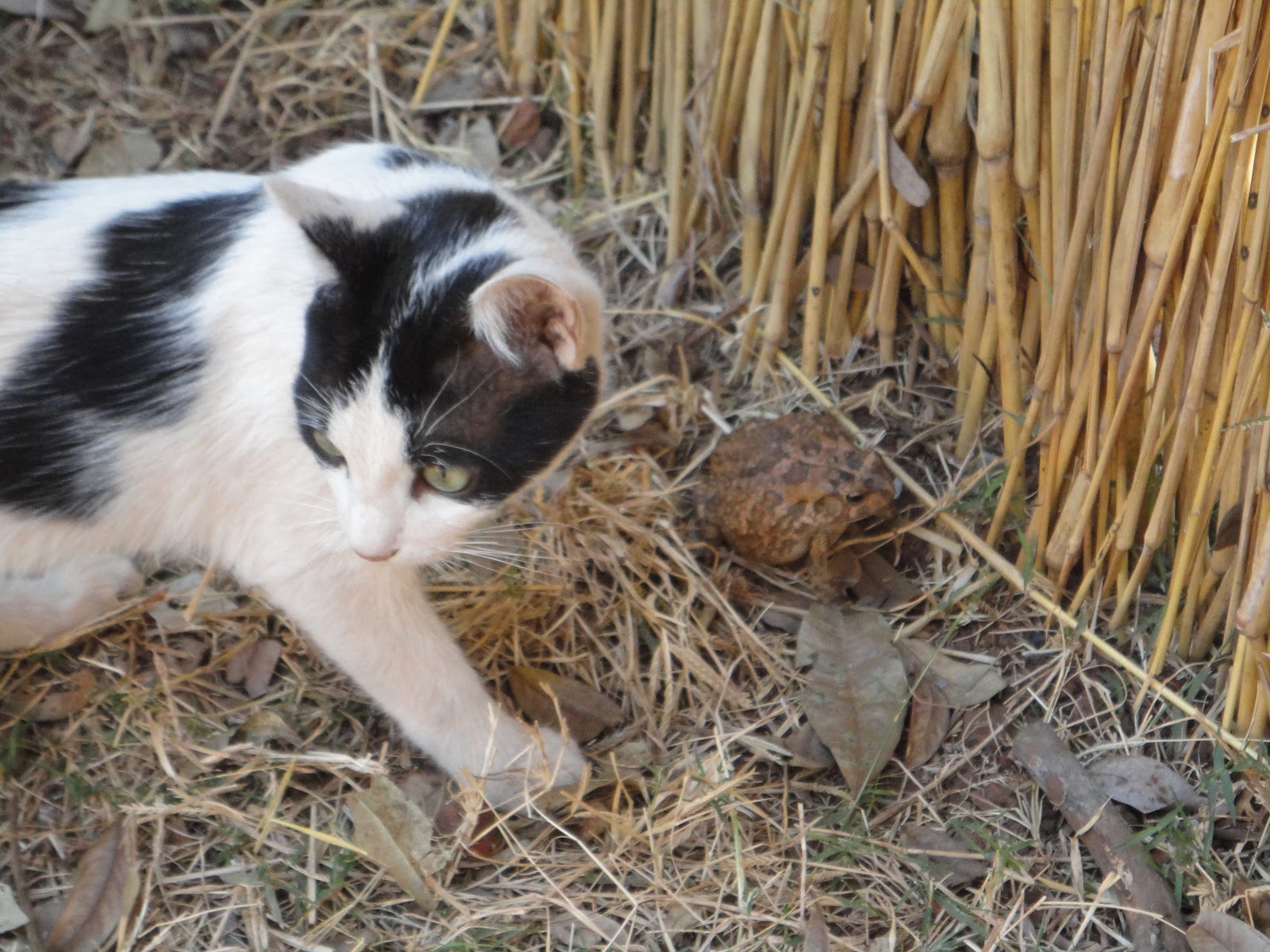
Today, after a marathon session of clothes washing, I was relaxing in the house knitting and listening to the BBC. Just like with a toddler, once I realized I hadn’t heard Kitty in a while, I started to worry. I headed outside to find her having cornered a toad by my latrine, thoroughly entertained by the fact that she could make this thing jump just by tapping it with her paw. She wasn’t hurting it, just tap-tap-tapping as it jumped around.
“Good job kitty! You discovered you can hunt! (Sort of).”
I scooped up the toad and moved it out of my yard, releasing it into some bushes. Last week, I had heard people yelling outside my fence, and turned around to see a three foot long orange snake winding toward me from the garden. The people were trying to warn me that it had entered my yard. Kitty was unfazed, and trotted behind it like a sheepdog herding it’s charges. She herded the snake right though out the other side of my yard, though I have a feeling that’s where it was headed anyway. Kitty got extra usipa that night.
Kitty was righteously angry with me for taking away her toy toad, until she saw the dirt beckoning and forgot all about me to take a nice dirt bath. Every night she licks herself clean and snuggles back under my arm. That’s my sweet Kitty.

Friday, August 12, 2011

Bats Bicycles and Bruises

Two weeks ago I decided to start the final assault on my house’s bat population. One of the four rooms has been locked for three months because even after the application of dubious nameless pesticides by my friends, the bats were refusing to leave. I put my bike in that room too, figuring it was the safest place in my house since the door was always locked. (I haven’t exactly been a cycling enthusiast here).
            Every once in a while I would unlock the door just long enough to say, yup, there’s an ever growing pile of bat manure, and it still stinks of bat. Bats have a very pungent smell. I didn’t realize it at the time, but when I moved in, my whole house stank of bat. It smelled bad, but I couldn’t put my finger on why. After lots of cleaning and cooking and living, the house finally just smells like me. But when I open that fourth room, the memory of my empty house floods back. Even the Peace Corps doctor, when I had pneumonia a few months ago, commented on it. After he came out for a site visit, he remembered the smell.
            “Are you airing out your house?” he had asked, when he was starting my IV, “I remember your house had this weird, musty smell…”
            So last week I got a new idea- to fight smell with smell. If the bats liked their acrid, musty smell in that room, then I would change it. First I sprayed some Doom in there. It wouldn’t kill the bats, but it stunk like hell. Then I sprayed a healthy dose of perfume, which made it sticky sweet. I forced open the creaky windows in the afternoons to try to waft in human smell. It started to work! I swept out the droppings every few days so that I could gauge if the amount was decreasing. The first sweep was dreadful. There were two dead bats on the floor, plus one that appeared in the last throes of death, convulsing whenever my (very long) broom touched it. The worst part? My bats have TAILS. Little spiky, inch-long black tails. Yuck.
            This past Saturday I found another stinky weapon. I had bought Cobra floor polish when I moved in, because I had heard that well polished cement floors are easier to keep clean. I polished once or twice that first month, but now I barely even bother to sweep (terribly unsanitary by Malawian standards, I know). Cobra, ostensibly, “Lavender scented”, smells like commercial grade floor wax with a big cheap bottle of perfume mixed in. I smeared it liberally on the bat room floor. It did make the cement shine. And ever since, the bat droppings have decreased from handfuls per day to only a few pellets. Only the room still smells bad. Just Cobra-polish bad rather than bat-bad.
Stay away, you flying rats with radar, stay away.
            Of course I had to take out my bike from the bat room before smearing the floor. And there was something about a brand new bike just sitting there, a little dusty but still shiny, that made me think, maybe I like riding bikes after all? Maybe I have gotten so much more in shape since I moved here that I won’t tucker out ten minutes from home? Oh yes, the bike was beautiful and Malawians ride bikes all the time. In fact, I was probably hindering my integration by NOT riding one.
            I dug through my clothes until I found my tight black capris, and folded my chitenge in half so that all the last vestiges of forbidden thigh were covered. I threw on my helmet and sunglasses and wheeled out the door. The neighbor kids were playing outside, and they squealed in delight to see my bike. I hopped on and wobbled out to the dirt road. My neighbor, Nelly, was out there, chatting on Martha’s stoop. She looked really worried.
            Mukupita kuti??”- Where are you going?
            Sindikudziwa!” –I don’t know!
            I rode past the Primary School in the direction out of town that I rarely took. In fact I had never been far this way except by car. I was surprised to see how quickly the landscape changed back to ‘rural village’. The trading centre where I had been doing most of my work really was a tiny oasis of development. I started huffing and puffing pretty hard. I was messing around with the gears but no matter what I did, pedaling seemed to get harder and harder. I had to stop several times, to the utter delight of the dozens of kids who had started running along side me. One of the times I stopped, I took off my sunglasses and tucked them into my chitenge. Of course as soon I started riding again, I heard a crunch, and looked back to see my sunglasses, which had managed to survive five months in Malawi, in three pieces. The lenses were ok though. I looked out at the kids and saw a girl, about five, who had a lazy eye. It was really profound- one eye looking straight ahead and the other gazing out sideways into the bush. I called her to come towards me but she freaked out and hid behind another girl. It took several minutes to get her to trust me, and I handed her the glasses. An older kid grabbed them out of her hand and I grabbed them back. I pointed at her.
            Basi,” -only her.
            I got back on my bike and huffed and puffed for another 100 meters. The kids were keeping up now just by walking. Other bikes whizzed past. 
            That’s when I noticed that my tires were flat.
            Because of course they were.
            I turned around and tried to coast on the slight incline back into the trading centre. The bike wouldn’t even coast. The kids trotted along side me, lazy eye girl holding the glasses to her face, as I huffed and puffed to go downhill. Ten minutes later I was headed past my neighbor again. She stared at me, looking more worried than before. In the middle of the trading center is the bicycle repair district. There are two main shops equipped with pumps, scrap metal bits, homemade (literally) welders, and LOTS of men just standing around. Fortunately I was still going downhill, so I did my best to roll off the dirt road over onto the dusty space in front of one of the shops. These guys had never seen me on a bike before, and I was definitely the center of attention. There was a wide ditch between the road and the repair booth, and I barely made it up the far side when I put my feet down to dismount. But I was still on a slope, and my right foot didn’t make contact with the ground. I tipped over to the right, and rolled back down the ditch, bike over body.
            Lovely, I thought, as my indecently-covered legs splayed out in an involuntary cartwheel.
            I hopped up again as quickly as I could, and wanted to say something like TAA DAA! But I didn’t know the Chichewa words for that. So I just smiled like a dope, covered from head to toe in dust, in front of the completely silent mass of men. I picked up my bike and wheeled it over to the guy with the pump, pointing to my flat tires. He pointed at my elbow, which had gotten scraped up and was bleeding. I shrugged.
            “Palibe vuto. Zoona.”- it’s no problem. Really.
            He looked at my tire and said he didn’t have the right pump. Check the shop next door. So with all the eyes silently following me, I wheeled over ten feet to the other shop and presented my tires. A three-man team, including a young bike repair apprentice, was soon fixing my tires. The head guy asked, in skeptical, halting English,
            “Who was it that taught you how to ride a bike?”
            “Oh,” my mind was blank, “um, I think I learned in school.”
            “Oh. Ok.”
            My tires were full again and I asked what I owed him. He laughed and said no charge. So I hopped back on and thoroughly enjoyed the 50 meter ride back to my house, passing my neighbor for the third time, this time dusty, sweaty and bloody. Riding suddenly took a lot less effort. I thought about heading back out on the open trail, but the prospect of hot tea at home suddenly seemed a lot more inviting.

            I decided to lock the door again to the bat room, to concentrate the smell of the floor wax. And for good measure I locked my bike away again too.  

Thursday, June 23, 2011

Manure Hunting


It’s starting to feel like the logo for Peace Corps Malawi should be something like: ‘Homesteading on a Shoestring’, or ‘Little House on the Savannah- the Next Generation’. Although the work of community health assessment continues, my attempts to turn my dusty, scorched-earth yard into an African Eden (or at least more green than brown) are intensifying.
            When I arrived in Chiwamba, it wasn’t yet the season for harvesting the grass reeds used for fences, so the health center staff used cardboard to create a little courtyard for my privacy. But then it became grass season, and I was ready to do some full on landscaping.
            I got out my khasu (like a short hoe) and started hacking at the ground, not really accomplishing anything. I built a rickety hand-washing station and a dish drying rack that had to lean against my house (and still fell over sometimes).
            “What am I missing?” I asked Chancy, my counterpart.
            “You have to wet the ground first, it’s too dry.”
            I tried to dig a rubbish pit, pouring my used dishwater in the hole each night to soften the earth. And it worked, to an extent. But not well enough to dig garden beds.
I was in Lilongwe that week and asked a veteran PCV there.
“Get a pick-axe,” he said, “the heavier the better.”
I found a nice huge pick-axe in town and had a lot of fun getting it back to my village. Hitchhiking was a no go- I looked like the grim reaper in a Chitenge. But even the axe couldn’t break the earth without first soaking it.
I needed a TON of water, and I couldn’t carry it all myself.
            After mapping out where I wanted my garden to be, I headed to the health center and talked to the guardians. These are women who travel with pregnant relatives who live far away. They come to the health center three weeks before the due date and sort of camp in an outbuilding, waiting to go into labor. The guardians take care of them before and after the birth.
            I hired two women to carry water from the borehole and soak the area that I wanted to plant. They were a little perplexed as to why I was planting during the dry season, but they were glad for the job. Then I took my pick-axe and khasu and hacked away at the earth until I got blisters. My night watchman, Botoman, found me covered in sweat and dirt. The beds were still only a few inches deep and my hands were bleeding.
            “What are you doing?” He asked in his baritone voice.
            “I want a dimba,” I said ”I want to grow my own tomatoes and onions.”
            He shook his head and made a tsk tsk sound, then took my axe and hoe. We made a deal that he would dig that night for some extra money. His wife is pregnant, so odd jobs are welcome. I heard the whack, whack of the pick-axe all night, but in the morning, there were my three garden beds, each a meter deep.
            “Great job, Botoman- they look like empty graves!” He smiled.
            That week the fence was also expanded, with the cardboard taken down and replaced by tall, dry grass. It enclosed my empty garden perfectly, shading it on three sides. Following one of the books on tropical vegetable gardening provided by the Peace Corps, I started filling the beds with organic rubbish, one at a time. Lots of leaves, paper, fruit peels and eggshells went into the pit. THEN the fun started. Once the rubbish was a few inches deep in the pit, I started going manure hunting.
            I began in the maize field between my house and the borehole. It belongs to the headmaster of the local primary school. I had him and his wife over for dinner and when I told them about my plans, they gave me permission to gather cow manure from the empty field. So every afternoon, when I ran out of other things to do, I took a bucket and trowel and went out gathering cow dung. It was pretty slow work, but after a few days, a woman on her way to the borehole took me to her house, where there were eight cows. I met the family and they said to take as much manure as I wanted. I carried six buckets back on my head that night, until the hole was filled with several inches of dung, and the rubbish was no longer visible. Then I mixed the soil that had been removed, and replaced it in the pit, topping it off with several inches of mulch. Every evening I wet the mulch, and now after a week and a half, the bottom layer has begun to rot. Soon it will be ready for planting.
            Now my rubbish is going into bed number two. And after all the careful observation of how the fencemakers plied the ground to make sturdy fenceposts, I tore down my rickety hand-washing station and dish drying rack and made new, firmly planted ones. I started a nursery beneath my hand-washing station, germinating cucumber and tomato seeds. Every time I wash my hands, the water drips on the nursery, conserving every drop.
            As much as I appreciate my neighbor with the cows, I don’t want to wear out my welcome. Plus I really enjoy the afternoon walks, exploring new trails, searching for dried poo. I discovered a really nice field behind the primary school where cattle had obviously been grazing recently. I can’t go near the school during classes, because seeing an Azungu stirs the kids into a frenzy, but there was still a teacher’s meeting going on. One of them leaned out the window.
            “Eliza, what is it that you are looking for?”
            “Ndikufuna manure! Ndidzkhala dimba!” I yelled back.
            “Oh.”
            A few seconds later I heard the room full of teachers roaring with laughter.
During training an experienced PVC told us that we will inevitably do so many culturally strange things during the first few months at site, that the people who are going to think we are nuts will probably come to that conclusion no matter what.
I take that as consolation when I am surprised by someone overhearing me talking to the manure, saying things like, “oh, you’re a nice big plop, yes you are! Hold on maggots, this is MY cow pie now!”
After a few days of this “wild” hunting, another neighbor saw me and led me to his pig farm, and said I could have two bucketfuls of pig poop. I was so excited that my Malawian pastor overheard me from the nearby trail. He helped me carry the manure home and looked intently at the garden beds.
“This is totally different,” he said “I think I may have to try this.”
I lent him a book on permaculture in Chichewa and went back out hunting.
Today the manure in bed two is basi- enough. I will go out and fill in the bed with soil, cover it with mulch, and start tossing rubbish in bed three. When all the beds are filled, I will make a proper compost pit and start planning the magnificent herb garden I have envisioned for the other side of my house. In the meantime, word is spreading about my garden. Nearly every day I get a shy visitor who wants to look at my different way of preparing the soil. I guess the proof will be in the vegetables, though.
Today, as I look out at my no longer scorched-earth yard, I am thinking- “How hard could it be to raise chickens???"

Sunday, May 15, 2011

Elizabeth goes on Med Hold

So in the two and a half weeks since I arrived at my site in Chiwamba, I have been sick all but about five days. It started as a cold, which morphed into a coughy- tight- chest thing. Being sick is no fun when you have to draw your own water and cook over fire- no spending the whole day in bed! Plus it was frustrating to finally be somewhere where I could actually do something and instead feel too weak :-(
After starting on some antibiotics last week, I felt better for long enough to walk out to some of the nearby villages where the HSA's were doing child nutrition campaigns. I helped measure children to screen for malnutrition while the HSA's gave out vitamin A and mebendazole for worms. We were able to identify several malnourished children who were then referred back to the Health Centre for supplemental feeding. After about three days of this, though, I started feeling crummy again. Two nights ago I had a fever and called the doc bac, who had me come into Lilongwe first thing yesterday morning.
I hitched out from my village to the main road with some missionaries (thank you!!!) and rode in the back of a truck into town (not fun- we were stopped at a police checkpoint for almost an hour...). The doc found me lying on the steps outside the clinic, out of breath. Some new meds and a bit of IV fluids later, I felt a little better. I told the doc that I hadn't eaten in two days and he took me out for a milkshake!!
So I will be in Lilongwe for a few days until I am fully recovered.
And then....hopefully....starting actual work in Chiwamba...

Wednesday, May 4, 2011

The Third Day in Chiwamba


On the morning of the third day at site, I was woken up by a gaggle of kids outside my window.
            “Eliza!, Eliza!”
            They were yelling something else in Chichewa that I didn’t understand. I looked at the clock- almost 6am. I should be getting up anyway.
            Mwadzuka,” I yelled back out the window- “good morning!”
            I pulled on a Chitenge and fumbled with my keys. When I got outside there were 8 children beaming, including one boy bursting with excitement. He was holding a terrified hedgehog, which he then pushed into my hands.
            “Where did you find this?” I asked, as I sat down and let the hedgehog uncurl and crawl around on my lap.
            Alipo,” he shrugged- “just around.”
            I had seen a hedgehog before in Mkonkera, and was told they were very rare. The hedgehog woke me up well; 90% prickly spines, 10% fleshy belly, with a long nose and black bead eyes. I gave it back to the boy.
            “I have something to show you too,” and I dashed inside.

            The day I had arrive in Chiwamba, to a house that had sat unoccupied for several years, was a blur. I was helping to sweep it out when I spotted a bat clutching the wall. I yelled to my neighbor, who hit it with a broom handle and carried it outside. When we finished sweeping, I went back to the spot where we had cleaned up massive amounts of droppings and looked up. There were dozens of bats sleeping on the backside of a rafter.
            With the squeaks and the droppings, I had assumed that my house was infested with rats, so I had loaded up on rat poison and traps in Lilongwe, but I had no clue what to do with bats.
            “Watch out,” my neighbor said, “ there are a lot of nyerere.” Ants. Biting ants I would soon find out.
            The bat room was where I had been planning on sleeping, so I moved all of my things to one of the back storage rooms. By the end of the day, I would be carrying water from the borehole and scouring my new bedroom, only to find that no amount of elbow grease could remove the years of grime on the cement walls.
            I decided to heat some water for a bucket bath, but I couldn’t light the charcoal. I soaked the briquettes in paraffin and fanned the tiny flame until my arm cramped, but the water only got lukewarm. I took a lukewarm bucket bath and went to bed.
           
            On the second day, I knew that I had to do laundry. I hauled a 30 liter bucket filled with dirty clothes to the borehole and started scrubbing.
            The borehole is a great place to meet people, since it is on a major path out to the maize fields. I greeted everyone who walked by in Chichewa, often explaining who I was and what I was going to be doing in Chiwamba.
            “You wash your own clothes?” Many people asked, “Who taught you do to that?”
            I realized as I finished that I didn’t have a clothesline yet. I had to dig though the endless bags of supplies from Lilongwe to find it. I had to move quickly-I was going to be late for a staff meeting at the health center.
            The five minute walk from my house to the health center turned into 15, as I stopped to greet a group of local chiefs. (“You always, always have time to greet the chiefs,” I had been told in training.) Of course the meeting started an hour late, so I shouldn’t have worried.
            Every few minutes, the head of the clinic would pause the Chichewa and ask me in English if I was following what was being said, then give me a big high five if I answered correctly. We laid out plans for my first few work days next week, observing some health workers in the field who were conducting a village assessment. After the meeting, there were still several hundred patients to be seen in the clinic, plus dozens more in antenatal, since the nurse was out for the day.
            “Come on,” the Medical Assistant grabbed me, “there is a woman bleeding.”
            I know that as a Peace Corps Volunteer I cannot do hands-on care, but the nurse in me rushed to see what was going on. A woman was lying on the delivery table, moaning. She was five months pregnant and hemorrhaging. I could smell the blood. Someone had already called an ambulance, and it pulled up just as we entered the room. Malawian ambulances are just cars with one driver, however, and the drive to a hospital would be at least an hour.
            “Can you start an IV?” I asked the MA.
            “Lets just get her in the ambulance and go.”
            We moved to the prenatal exam room where I observed a basic visit. I felt the belly of a very pregnant woman. In nursing school, I always had trouble finding the lay of the baby, but on this slim Malawian, I could feel the curve of the head, the shoulder, even a leg as it moved. The mother smiled.
            Suddenly there was a gasp outside. While the bleeding woman was being carried out to the ambulance, she had given birth. The MA ran out to help, and I started praying under my breath. I gave them a minute and then ran out to join them. I didn’t want to get in the way.
            “Is it alive?”
            “Yes, for now.”
            I looked though a tiny window into the car to see the mother lying on the floor. Another woman was holding a tiny wet bundle. I could see a head move a little.
            I grabbed the driver, who I knew spoke a little English.
            “Tell her to wrap the baby in at least two more blankets! It has to stay warm!”
            “OK,” he grunted as he drove away.
            I poked my head back in the exam room window and told the MA that I was going home.
            “Eat first!” He pointed to a bench with nsima and fried fish laid out. I didn’t have an appetite. I grabbed an attendant and told her that I was very sorry to miss lunch, but I needed to go home.
            I got out to the road just in time to see the “ambulance” disappear over the crest of a hill.

            Looking down, I saw a bright green chameleon on the packed dirt. It was the first one I had seen in Malawi. I kept an identical chameleon as a pet in Uganda and name him True Love. This would be True Love 2, I decided, as I picked it up. It hissed and turned brown in self-defense, but soon calmed and sauntered up and down my arm as I walked home. I put it in a cardboard box with some grass and water. After a while, I “hunted” three grasshoppers and put them in the box, watching as True Love 2 shot out his long, elastic tongue to devour them.
            Realizing that I hadn’t yet eaten that day, I tried to start a fire. I was terribly slow, and an hour later I had only some very soggy rice. I cleaned my house a bit more, took in my laundry, and had another cold bucket bath.

            On the third morning, I wanted to show the hedgehog kids my chameleon. The girls shrieked as I brought True Love 2 out.
            “It will bite you!” the said.
            “No,” I laughed, “chameleons don’t bite. Let’s hunt grasshoppers.”
            We tromped through the field next to my house, catching grasshoppers for the chameleon’s breakfast. But though they were big and juicy, he refused to eat. I noticed that the nyerere had gotten into his box.
            “Let’s let him go.”
            The kids and I spent 15 minutes searching for the perfect spot, then we said goodbye as True Love 2 slowly walked back into the bush. We let the hedgehog go too.
            I took the kids back to my house and showed them my hand-washing station- a must for proper sanitation without running water.
            We sat in a circle and played the Chichewa version of duck-duck-goose; khuku-khuku-g’nombe (chicken- chicken- cow). We had a great time.
            Eventually I shooed them all out, realizing that I needed to cook something. I started the fire a bit faster this time, and filled a pot with water and pasta. But it still wouldn’t boil. I threw the soggy/crunchy pasta out behind my house, where some hungry dogs had been waiting for my latest failed attempt at cooking to get tossed.
            I plopped down in my very grimy living room, exhausted. I needed to scrub the whole room, but it was so hot, and I hadn’t eaten in a while, and I had no energy.
            Three of the boys from that morning were still hanging out in front of my house. I got an idea, and tried my best in Chichewa to explain-
            “You scrub, I pay 50 kwacha.”
            It took about three attempts before they understood and agreed. We went through three big bucketfuls of water, half a bottle of lavender castile soap, five sponges and a lot of dripping sweat, but finally I felt that my living room was habitable. In fact I was so happy that I gave them 100 kwatcha each. (In retrospect, probably a mistake, forever sealing my reputation in their minds as the rich American.)
            Remembering how hungry I was, I walked into town to get chippies (like homemade French fries) and a Fanta.
            I was still putting the finishing touches on my living room when the kids came back. The youngest, my four-year old neighbor, presented me with a handful of grasshoppers she had caught for me.  I think she must think that hunting grasshoppers is a hobby of mine!
            I told the kids that I wanted to start a fire.
            Together we soaked the charcoal in paraffin, just as I had done before. But again the fire wouldn’t last.
            “Put some grass on it.”
            I went out to get some grass.
            “No- this kind,” he showed me the thick reeds I had seen as thatch on people’s roofs. He broke it into pieces and shoved it into the charcoal, fanning the mixture until it was glowing red. I put a pot of water on top.
            Every few minutes as we watched the fire, they offered more advice.
            “Put more grass on.”
            “Fan it a little more”
            “Just wait.”
            And then suddenly, the water was boiling. And for the first time in Chiwamba, I had a hot bucket bath.

            I had heard from a fellow PCV that the kids are always the first to accept and teach the new azungu in town, and it’s true.  When I shooed them away that night, I told them to be sure and come back tomorrow.